


Page 86 - InvestmentGuideBrasilEng
P. 86
Real Estate   Over the past seven years the real estate sector has undergone   MALLS
 significant development and diversification in Brazil. During this
 & Hospitality  period the most important domestic developers have conduct-  Not only housing markets is doing well in Bra-  now has a GLA of 11,403. There are plenty of op-
 ed IPOs, a large number of new Real Estate Investment Trusts
            zil. After a US$ 4 Billion record in Foreign Direct
                                                    portunities in secondary cities in Brazil – those
 (REITs) and hospitality related funds have begun operating and
 sophisticated new instruments with strong returns have been   Investment for 2012 there are also promising   with less than than 500,000 people – where a
 introduced to the market. In the early 2000s there was almost   numbers for office development and retail, spe-  number of major groups are expanding in various
 no private equity activity in Brazil. Now some experts estimate   cifically  shopping  centers.  Since  the  late  90s,   Brazilian states.  The shopping center industry
 that there is at least US$10 billion available in funds from the   Brazilian malls have been revamping their lay-  accounts for 18.3% of the national retail market
 United States, United Kingdom, Canada and the Middle East,   outs and testing new configurations to leverage   and almost 3% of the country’s GDP, employing
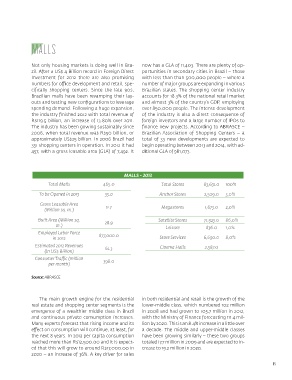
 ready to invest in the country.    spending demand. Following a huge expansion,   over 850,000 people. The intense development
            the industry finished 2012 with total revenue of   of the industry is also a direct consequence of
            R$119.5  billion,  an increase  of 13.80%  over 2011.   foreign investors and a large number of IPOs to
            The industry has been gowing sustainably since   finance new projects. According to ABRASCE –
            2006, when total revenue was R$50 billion, or   Brazilian  Association of Shopping Centers – a
            approximately US$25 billion. In 2006 Brazil had   total of 33 new developments are expected to
            351 shopping centers in operation. In 2012 it had   begin operating between 2013 and 2014, with ad-
            457, with a gross leasable area (GLA) of 7,492. It   ditional GLA of 981,073.
 HOUSING


 Anchored by a steady level of consumer demand,   sia at 10.7%. This has led Brazil to be considered,   MALLS - 2013
 credit expansion  and rising  income since  2003,   for the second consecutive year, the most attrac-  Total Malls  465.0  Total Stores  83,631.0  100%
 the Brazilian government and the private sector   tive emerging market to invest in and the sec-
 have jointly worked to improve housing supply for   ond-most effective in generating capital gains,   To be Opened in 2013  33.0  Anchor Stores  2,509.0  3,0%
 the  population.  According to  the  Brazilian  Cen-  second  only  to  the  USA,  according  to  AFIRE  –
 tral Bank, secured lending represents only 6.3%   Association of Foreign Investors in Real Estate.    Gross Leasable Area   11.7  Megastores  1,673.0  2,0%
                 (Million sq. m.)
 of the country’s GDP, compared to 15% in Mexico   Despite the house price boom in the country, a
 and Chile, 60% in Spain and 70% in the USA. Risky   recent survey by FGV – Fundacao Getulio Vargas –   Built Area (Million sq.   Satellite Stores  71,923.0  86,0%
 markets that have experienced bubbles and crises   points out that, compared to countries in Europe   m.)  28.9  Leisure  836.0  1,0%
 reached rates higher than 50% of GDP for lending.    and Asia, Brazilian prices are still quite cheap. For   Employed Labor Force
 Moreover, Brazilian home lending mechanisms   instance, the average price per square meter in   in 2012  877,000.0  Store Services  6,690.0  8,0%
 are very conservative by nature. For example, it’s   London is US$21,460.00, US$15,122.00 in China   Estimated 2012 Revenues
 not possible to finance more than 80% of the prop-  and US$6,931.00 in Brazil.  (In US$ Billion)  61.3  Cinema Halls  2,587.0
 erty’s value or to approve additional mortgages for   Consumer Traffic (million
 the same property, which is different than certain   per month)  398.0
 other markets. In 2003 the SFH – Housing Financ-
 ing System – lent R$2.21 billion to finance 36,480   Source: ABRASCE
 properties; in 2012 R$82.76 billion was lent to fi-
 nance 453,209 units, for an increase of 4,575%.
 With housing deficit level estimates ranging
 between 5 and 7 million, there is still a huge mar-  The main growth engine for the residential   in both residential and retail is the growth of the
 ket for real estate development – notably in the   real estate and shopping center segments is the   lower-middle class, which numbered 102 million
 low-income segment. For this reason, the gov-  emergence of a  wealthier  middle  class in  Brazil   in 2008 and had grown to 105.7 million in 2012,
 ernment is expected to boost “Minha Casa, Minha   and continuous private consumption increases.   with the Ministry of Finance forecasting 111.4 mil-
 Vida” program in the coming years. In addition,   Many experts forecast that rising income and its   lion by 2020. This is an 8.4% increase in a little over
 according to the Knight Frank Global House Price   effect on consumption will continue, at least, for   a decade.  The middle and upper-middle classes
 Index  – an index that monitors housing prices   the next 8 years. In 2012 per capita consumption   have been growing similarly – these two groups
 in 55 countries - Brazil was the country with the   reached more than R$12,500.00 and it is expect-  totaled 17.7 million in 2009 and are expected to in-
 highest increase in 2012, growing 15.2%, followed   ed that this will grow to around R$17,000.00 in   crease to 19.2 million in 2020.
 by Hong Kong at 14.2%, Turkey at 11.5% and Rus-  2020 – an increase of 36%. A key driver for sales
 84                                                                                                85

