


Page 49 - InvestmentGuideBrasilEng
P. 49
EMBRAPA: THE BRAZILIAN                  NEW INFRASTRUCTURE                                         BRAZIL’S FARMING MODEL                  150 kilometers of Brazil’s national territorial
                                                                                                                                                                ? Where the rural property is located within
                  AGRICULTURAL RESEARCH                   INVESTMENT WILL FURTHER                                    Farming in Brazil is immensely diversified, ranging   borders, which are called border areas, the
                                                                                                                                                             foreign investor also needs to apply to INCRA,
                  CORPORATION                             SUPPORT AGRICULTURE                                        from family small holdings to huge commercial ru-  which will submit an application to the National
                                                                                                                                                             Defense Council for a decision on whether
                                                                                                                     ral estates. The actual area of farms varies deeply
                                                                                                                     depending on the region they are located. A con-  the sale or rental is to be authorized, before
                  Advances in farming techniques and technolo-  New transportation and logistics infrastructure      siderable part of Brazilian agribusiness is organized   being sent to INCRA for a final decision.
                  gy have been pioneered by the Brazilian Agricul-  networks currently being built under federal     into cooperatives, mainly in the south region. Fam-
                  tural  Research  Corporation  (EMBRAPA),  whose   investment programs such as the  Accelerated     ily farming also plays a strategic role, producing     ? A non-Brazilian national cannot purchase
                  research is responsible for the internationally   Growth Program and the Logistics Investment      almost half of the corn crop and over a third of the   land in excess of 50 MEIs (i.e. between 250 to
                  renowned opening of Brazil’s Midwestern cerra-  Program will further drive growth in new agri-     coffee crop consumed in Brazil each year. However,   5,000 hectares depending on the locality).
                  do region to farming soybean, cotton, corn and   cultural regions by enabling producers to effi-   large international groups such as ADM, Agrium,   In the case of foreign entities, this cap is
                  other crops. Today, EMBRAPA is on course to re-  ciently transport their crops to consumer centers   Bunge, Cargill, Louis Dreyfus and Syngenta have es-  100 MEI (from 500 to 10,000 hectares).
                  peat its success by opening up a new agricultural   in Brazil and to ports for export to international   tablished strong operations in Brazil.  Irrespective of these two caps, the law stipulates
                  frontier in a region called MATOPIBA, which is the   markets. Brazil’s main export markets for agricul-                                    that no more than 25% of a municipality’s
                  name given to new agricultural production in the   tural products are the European Union, China, the                                       territory can be under foreign ownership.
                  states of Maranhao, Piaui, Tocantins and Bahia.   United States, Russia and Japan.                 INVESTMENT IN RURAL
                     EMBRAPA is a public company whose mission   As a result of innovation and excellent grow-
                  is to provide feasible solutions for the sustainable   ing conditions, farming in Brazil does not depend   REAL ESTATE                     COMMITMENT
                  development of Brazilian agribusiness. Since its   on government subsidies to be competitive. Ac-
                  creation in 1973, EMBRAPA has supported the   cording to the OECD-FAO  Agricultural Outlook                                                TO SUSTAINABLE
                  creation of over 9,000 technological products   for 2010-2019, “Brazil is the fastest growing agri-  In order to ensure the effective administration of ru-
                  for use in Brazilian agriculture. From its national   cultural sector by far, growing by over 40% up to   ral areas and regional development policies, there
                  headquarters in Brasilia, EMBRAPA operates a   2019, when compared to the 2007-09 base peri-       are certain restrictions on the size and nature of real   AGRICULTURAL
                  countrywide network of 47 research centers and   od.” Brazil is already the top global supplier for a   estate that foreign investors can purchase or rent. It
                  participates in cooperation activities with a wide   wide range of agricultural commodities, includ-  is important to note that Brazil’s Constitution does   DEVELOPMENT
                  range of international partners.        ing beef, orange juice, soybeans, sugar, tobacco,          not prohibit the acquisition or leasehold of rural real
                  www.embrapa.br/english                  coffee, ethanol, poultry and cellulose, despite the        estate by non-Brazilian nationals.      What is unique about Brazil’s agricultural devel-
                                                          fact that approximately 70% of production is tar-             The main restrictions on rural real estate ac-  opment is that it is compatible with sustainable
                                                          geted at the domestic consumer market.                     quisition and rental by non-Brazilian nationals   development and environmental conservation.
                                                                                                                     and foreign entities are:               The Government of  Brazil is  committed to  sus-
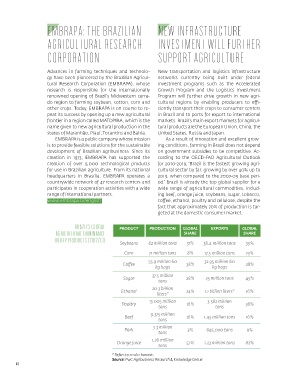
                            BRAZIL’S GLOBAL   PRODUCT  PRODUCTION  GLOBAL    EXPORTS    GLOBAL                                                               tainable economic development, with special
                     AGRICULTURAL DOMINANCE                        SHARE                SHARE                           ? Where the rural property in question is   attention being paid to illegal deforestation. As a
                     IN KEY PRODUCTS (2012/13)  Soybeans  82 million tons  31%  38.4 million tons  39%               greater than 3 MEIs (Modulo de Exploracao   result of government action to preserve the Ama-
                                                                                                                     Indefinida), a unit of measurement that varies
                                                                                                                                                             zon Rainforest, in 2009 Brazil recorded the lowest
                                                                                                                     in size depending on its location in Brazil and   rate of deforestation in the past 20 years. The Bra-
                                              Corn     71 million tons  8%  17.5 million tons  19%
                                                                                                                     ranges from 5 to 100 hectares, the foreign   zilian Forestry Code, which consolidates relevant
                                                      55.9 million 60     32.95 million 60                           investor needs to apply to the National Institute   federal legislation, is one of the most rigorous in
                                             Coffee                 38%                  28%
                                                         kg bags             kg bags                                 for Rural Development and Land Reform   the world. The Code was updated in 2012.
                                                        37.5 million                                                 (INCRA) for authorization. The authorizing   Brazil has the lowest carbon emissions among
                                             Sugar                  28%    25 million tons  45%
                                                          tons                                                       document must be produced along with    the world’s largest agricultural producers.
                                                        20.3 billion                                                 other required documentation in order to
                                             Ethanol                24%    1.1 billion liters*  16%                  register ownership or leasehold of the land
                                                         liters*
                                                       13.005 million       3.582 million                            with the competent Land Registry Office.
                                             Poultry                16%                  36%
                                                          tons                tons
                                                       9.375 million
                                              Beef                  16%   1.45 million tons  16%
                                                          tons
                                                        3.3 million
                                              Pork                  3%     645,000 tons   9%
                                                          tons
                                                        1.26 million
                                           Orange juice             57%   1.23 million tons  82%
                                                          tons
                                         * Refers to 2011/12 harvest.
                                         Source: PwC Agribusiness Research & Knowledge Center.
       48                                                                                                                                                                                                   49

