


Page 2 - Brazil AgrobusinessEng
P. 2
AGRICULTURAL INDUSTRY


         The organic market is heating up ... !!


         Consumers are increasingly interested in sustainability and healthy nutrition. And they are willing
         to pay more for these differences.
         Brazil is established as a major producer and exporter of organic food, with over 15,000 certified
         and transitional foods - 75% owned by family farmers.
         Support for organic production is present in various actions of the Brazilian Government, which
         provides specific funding lines for the agricultural sector and encourages the transition from
         traditional crops to organic production.
         Through this process, organic farming is growing in Brazil. But how do you know if a production is
         non-organic? Simple! If the production system does not use synthetic fertilizers, agrochemicals,
         growth regulators or synthetic feed additives, it is organic.
         The management of organic farming assesses the effective use of non-renewable natural
         resources as well as the use of renewable natural resources and biological processes in relation
         to biodiversity, the environment, economic development and the quality of human life.
         This agricultural practice deals with the health of humans, animals, plants and soil, using as a
         production model the adoption of unifying techniques that are not very aggressive to the
         environment and focus on crop diversity.

         Meet the basics of the history of organic farming / Registrations and certifications
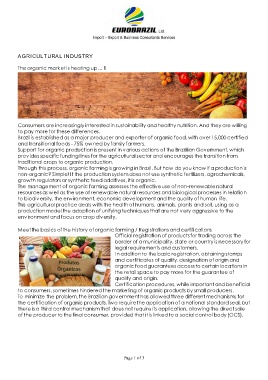
                                                    Official registration of products for trading across the
                                                    border of a municipality, state or country is necessary for
                                                    legal requirements and customers.
                                                    In addition to the basic registration, obtaining stamps
                                                    and certificates of quality, designation of origin and
                                                    organic food guarantees access to certain locations in
                                                    the retail space to pay more for the guarantee of
                                                    quality and origin.
                                                     Certification procedures, while important and beneficial
         to consumers, sometimes hindered the marketing of organic products by small producers.
         To minimize the problem, the Brazilian government has allowed three different mechanisms for
         the certification of organic products. Two require the application of a national standard seal, but
         there is a third control mechanism that does not require its application, allowing the direct sale
         of the producer to the final consumer, provided that it is linked to a social control body (OCS).


                                                        Page 1 of 3

