


Page 32 - InvestmentGuideBrasilEng
P. 32
CHALLENGES AND   LATEST ECONOMIC DATA  DYNAMIC ECONOMY

 OPPORTUNITIES IN THE   For the latest economic indicators, the Brazilian
 Central Bank provides monthly charts in English.
 NEW BRAZIL  For the most recent edition, please click on the
 following link:  http://www4.bcb.gov.br/pec/gci/
 ingl/Economic_Chart_Pack.pdf    WITH A LARGE
 There is still much to be done to ensure that the
 economy continues to grow in the years ahead.
 Brazil is not isolated from the global economy and
 in recent years turbulent headwinds from the Euro-  DOMESTIC MARKET
 pean sovereign debt and banking crisis have caused
 Brazil’s growth to decrease to more moderate rates.
 Yet Brazil remains a compelling opportunity
 for international investors seeking to create a new
 business venture or expand their international   Brazil’s prospects have never been better. Brazil is
 operations. Local demand remains robust, unem-  a market of superlatives, from being the world’s
 ployment rates remain at historical lows and FDI   top producer and exporter of major food and
 inflows are at record highs.   resource commodities to leading market growth   as a result of wage growth and record low unem-
 At the same time, not all of Brazil’s challeng-  and share in consumer retail. But much has yet to   ployment rates. Upward social mobility, shown by
 es come from abroad. Important reforms are   be achieved. Major investments are planned in the   an increase in the emerging middle class, is creat-
 being carried out to address internal growth   infrastructure and energy sectors.  ing a huge demand for consumer products. Brazil’s
 constraints.  These  internal  challenges  are  in   demographic profile is a further positive charac-
 themselves a source  of opportunity for interna-   teristic, as the vast majority of the population falls
 tional investors, such as the government’s recent   within the economically active range.
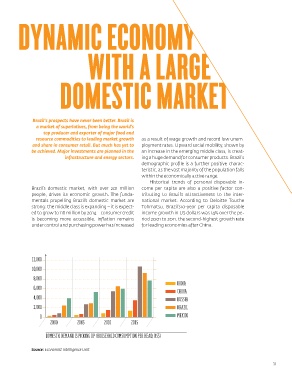
 decision to open Brazil’s infrastructure assets to    Historical trends  of personal  disposable  in-
 private investment.  The whole economy stands   Brazil’s domestic market, with over 201 million   come per capita are also a positive factor con-
 to benefit from a more efficient, modern and en-  people, drives its economic growth.  The funda-  tributing to Brazil’s attractiveness to the inter-
 hanced infrastructure network as a result of this   mentals propelling Brazil’s domestic market are   national market.  According to Deloitte  Touche
 ambitious program, which will reduce costs for   strong: the middle class is expanding – it is expect-  Tohmatsu, Brazil’s10-year per capita disposable
 doing business and generate further investment.  ed to grow to 118 million by 2014 – consumer credit   income growth in US dollars was 14% over the pe-
 One of the main challenges facing the Bra-  is becoming more accessible, inflation remains   riod 2001 to 2011, the second-highest growth rate
 zilian economy is increasing its investment rate.   under control and purchasing power has increased   for leading economies after China.
 From 2008 it has reached new heights, which
 have fluctuated between 18% and 20% of GDP. The
 goal of the Government is to increase gross fixed
 capital formation even further in order to ensure
 sustainability and accelerate economic growth.
            12,000
            10,000

 65          8,000
 60          6,000                                               INDIA
 55          4,000                                               CHINA
                                                                 RUSSIA
 50          2,000                                               BRAZIL
 45                                                              MEXICO
 40            0   2000      2005     2010      2015
 35
 10             DOMESTIC DEMAND IS PICKING UP HOUSEHOLD COMSUMPTION PER HEAD; US$
 2002  2003  2004  2005  2006  2007  2008  2009  2010  2011  2012
 Source: Brazilian Central Bank, Ministry of Finance  Source: Economist Intelligence Unit
 CONSOLIDATED PUBLIC SECTOR NET DEBT, AS % OF GDP
 30                                                                                                31

