


Page 9 - Fine Mediterranean Gourmet ProductsEng
P. 9
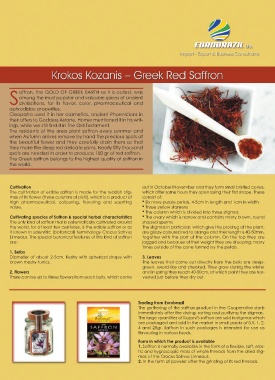
affron, the GOLD OF GREEK EARTH as it is called, was
         among the most popular and valuable spices of ancient
     Scivilizations,  for  its  flavor,  color,  pharmaceutical  and
     aphrodisiac properties.
     Cleopatra used it in her cosmetics, ancient Phoenicians in
     their offers to Goddess Astarte, Homer mentioned it in his writ-
     ings, while we still find it in The Old Testament.
     The residents of the area plant saffron every summer and
     when Autumn arrives remove by hand the precious spots of
     the beautiful flower and they carefully drain them so that
     they make the deep red delicate yarns. Nearly fifty thousand
     spots are needed in order to produce 100 gr of red saffron.
     The Greek saffron belongs to the highest quality of saffron in
     the world.


     Cultivation                                               out in October/November and they form small bristled cones,
     The cultivation of edible saffron is made for the reddish stig-  which after some hours they open losing their first shape. These
     mas of its flower (three columns of pistil), which is a product of  consist of:
     high  pharmaceutical,  collouring,  flavoring  and  scenting  * Six navy-purple petals, 4-5cm in length and 1cm in width
     value.                                                    * Three yellow stamens
                                                               * The column which is divided into three stigmas
     Cultivating species of Saffron & special herbal characteristics  * The ovary which is narrow and contains many brown, round
     The only kind of saffron that is systematically cultivated around  shaped sperms
     the world, for at least ten centuries, is the edible saffron or as  The stigmas in particular, which give the prodrug of the plant,
     it known in scientific (botanical) terminology Crocus Sativus  are glossy coloured red to orange and their length is 40-50mm,
     Linneaus. The special botanical features of this kind of saffron  together with the part of the column. On the top they are
     are:                                                      jagged and because of their weight they are drooping; many
                                                               times outside of the cone formed by the petals.
     1. Bulbs
     Diameter of about 2-3cm, fleshy with spherical shape with  3. Leaves
     brown meshy tunics.                                       The leaves that come out directly from the bulb are deep-
                                                               green, sword-like and streaked. They grow during the winter
     2. Flowers                                                and in spring they reach 40-50cm, at which point they are har-
     There can be up to three flowers from each bulb, which come  vested just before they dry out.


                                                             Trading from Eurobrazil
                                                             The gathering of the saffron product in the Cooperative starts
                                                             immediately after the drying, sorting and purifying the stigmas.
                                                             The large quantities of Kozani’s saffron are sold in stigmas which
                                                             are packaged and sold in the market in small packs of 0.5, 1, 2,
                                                             4 and 28gr. Saffron in such packages is intended for use as
                                                             flavouring in various foods.
                                                             Form in which the product is available
                                                             1. Saffron is normally available in the form of a flexible, soft, elas-
                                                             tic and hygroscopic mass of whole threads from the dried stig-
                                                             mas of the Crocus Sativus Linneaus.
                                                             2. In the form of powder after the grinding of its red threads.

