


Page 22 - InvestmentGuideBrasilEng
P. 22
Territorial   Brazil is a federation, administratively divided into twenty-six   THE NORTHEAST  ment, with considerable success.

 states and one Federal District, each with its own independent lo-
                                                       Pernambuco and Bahia were the first major
 Organization    cal government. The states are in turn grouped into regions.   STATES: MARANHAO, PIAUI, CEARA, RIO GRANDE DO NORTE,   centers of colonial Brazil and they still exert a very
            PARAIBA, PERNAMBUCO, BAHIA, ALAGOAS, SERGIPE
                                                    strong influence on Brazilian culture. Much of what
 The regions of Brazil are geographic areas that group neigh-
 of Brazil  boring states together. The regions are used for statistical and cul-  One of the fast-growing regional economies in   is characteristically Brazilian in music, folklore and
                                                    cuisine  originated  in  this  region.  Both  Ceara  and
 tural purposes only; there is no regional level of government. There
            Brazil, the Northeast is situated in an area that
                                                    Maranhao ports of Pecem and Itaqui are import-
 are five regions in Brazil, described below.
            encompasses both the arid  caatinga and the   ant hubs for agricultural and iron ore exports.
            semi-arid  cerrado biomes.  Vast stretches of this
            region, which contains nearly 30% of the Brazil-
            ian population, are subject to frequent drought.
 THE NORTH  ies in the region are Manaus, capital of the state   Industrial development is an important and  THE MIDWEST
            fast-growing sector in the region. Salvador, the  STATES: FEDERAL DISTRICT, GOIAS, MATO GROSSO, MATO
 of  Amazonas and an important manufacturing
 STATES: AMAZONAS, PARA, ACRE, RONDONIA, RORAIMA,   cluster as Brazil’s largest Free  Trade Zone, and   largest city in the region and the capital of the  GROSSO DO SUL
 AMAPA, TOCANTINS  Belem, capital of the state of Para, which has an   state of Bahia, has an important manufacturing
 important maritime port. The Amazon is an im-  cluster, while Recife, the second-largest metro-  This region, covered with extensive savannah and
 This region lies mostly within the Amazon basin   portant trade corridor, with a lot of goods shipped   politan area in the region and capital of the state   tropical grasslands (cerrado), is still sparsely popu-
 and the territory is dominated by rainforest and   by barge between Manaus and Belem for onward   of Pernambuco, is home to the Suape Industrial   lated. Once one of the more isolated areas of the
 numerous tributaries of the  Amazon River. By   shipment to the Brazilian domestic and interna-  Complex and the Recife Digital Port, an ICT inno-  country, this region has experienced a rapid expan-
 volume, this area holds the largest concentration   tional export markets. The state of Para is an im-  vation hub. Sizable oil fields and mineral deposits   sion of its rural production and established new
 of freshwater in the world and one-fifth of the   portant mining center, home to the Carajas Iron   are located in the region, and in recent years the   industries. The national capital, Brasilia, founded
 planet’s freshwater reserves. The two largest cit-  Ore Mine, the largest iron ore mine in the world.  Federal Government (through the Northeastern   in 1960, was moved to this region when the then
            Brazil Development Agency – SUDENE) has been   President Juscelino Kubitschek made the decision
            giving the Northeast special attention. Signifi-  to move the capital of Brazil to the heart of the
                                                    country as part of a national economic develop-
            cant resources have been allocated to its improve-
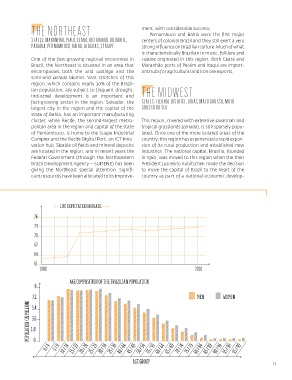
 B R A Z I L  I N  NU MBE R S  LIFE EXPECTATION IN BRAZIL
 DEMOGRAPHICS


             76
             73
   ? Brazil is the 5 -largest country     ? Largest cities
 th
 in the world by population.  Sao Paulo (11.4m), Rio de Janeiro (6.4m), Salvador   70
 (2.7m), Brasilia (2.6m), Fortaleza (2.5m), Belo   67
   ? Demographic Dividend: Brazil’s   Horizonte (2.4m), Manaus (1.9m), Curitiba (1.8m),
 population is highly concentrated   Recife (1.6m), Porto Alegre (1.4m)  64
 in the working-age range   61
   ? Ethnicity  1980                                                   2010
   ? 40 million Brazilians have entered   white 48.2%,
 the middle class since 2002  mixed ancestry 44.2%,   AGE COMPOSITION OF THE BRAZILIAN POPULATION
 black 6.9%,   9
   ? 22 million Brazilians have been lifted   Asian 0.7%,
 out of extreme poverty since 2011  indigenous peoples of Brazil 0.7%   7.2  MEN  WOMEN

   ? Total population    ? Religion  5.4
 201.032.714 million (2010 Census)   No State religion exists in Brazil; the Constitution   3.6
 guarantees freedom of belief and expression.   POPULATION IN MILLION
   ? Population living in urban areas  Most of the population are Christan (64.6% Ro-  1.8
 84% of total   man Catholic and 22.2% Protestant). 8% declare
 themselves to have no religion, while 2% are   0
   ? Language  Spiritist.  0 / 4  5 / 9  10 / 14  15 / 19  20 / 24  25 / 29  30 / 34  35 / 39  40 / 44  45 / 49  50 / 54  55 / 59  60 / 64  65 / 69  70 / 74  75 / 79  80 / 84  85 / 89  90 / 94  95 / 99  95 / 99
 Portuguese
                                                 AGE GROUP
 20                                                                                                21

